
Tesla’s Real Constraint: Capital Rigidity and Ramp Execution Risk
Tesla’s growth narrative centers on AI, autonomy, and expansion.
But the latest 10-Q highlights a more structural issue: ramp execution under capital rigidity.
1. Growth Requires Continuous Production Scaling
The filing repeatedly references risks tied to product development delays and production ramp-ups.
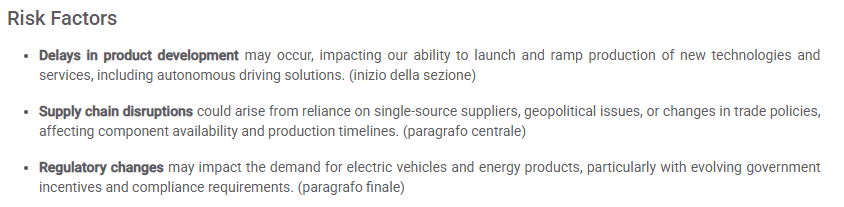
Screenshot: Risk Factors – Delays in product development and ramp production language.
This creates a structural pattern:
- High fixed manufacturing base
- Execution dependency
- Sensitivity to supplier disruption
- Margin volatility during transitions
In capital-intensive manufacturing, timing matters more than demand.
2. Capital Must Be Continuously Deployed
Tesla does not pay dividends and does not signal capital return prioritization.
Screenshot: Dividend Policy – No dividends declared or anticipated.
This reinforces a reinvestment loop:
- Infrastructure expansion
- Technology development
- Battery supply commitments
- AI-related strategic investments
Capital is committed before outcomes are certain.
3. The xAI Investment Extends the Risk Surface
The 10-Q discloses a $2B investment in xAI preferred shares.
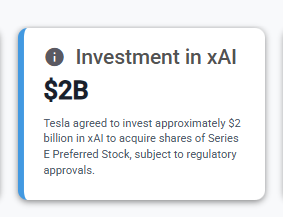
Screenshot: Other Information – $2B investment in xAI.
This does not create immediate risk. But it increases strategic dispersion.
Capital allocation complexity grows when core operations already require constant execution precision.
Structural Takeaway
Tesla’s financial model is not fragile because demand is weak.
It is sensitive because execution tolerance is low.
When production, supply chain, and capital deployment operate at high intensity, small disruptions compound quickly.
This analysis was extracted directly from Tesla’s 10-Q using StockCompass.
Analyze your next filing here: https://stockcompass.io
Structural risk rarely shows up in headlines. It shows up in filings.