
Northrop Grumman: War Exposure, Government Dependency, and Hidden Financial Risks

Northrop Grumman (NYSE: NOC) is one of the largest defense contractors in the world. The company designs and builds advanced military systems, including:
- Stealth aircraft and aerospace systems
- Missile defense technologies
- Cybersecurity and intelligence systems
- Space and satellite infrastructure
In a world shaped by rising geopolitical tensions — from the Middle East to Eastern Europe — companies like Northrop Grumman are directly exposed to war dynamics.
But while increased defense spending may appear positive on the surface, the company’s latest 10-K reveals a more complex reality.
1. A Business Built on Government Dependency
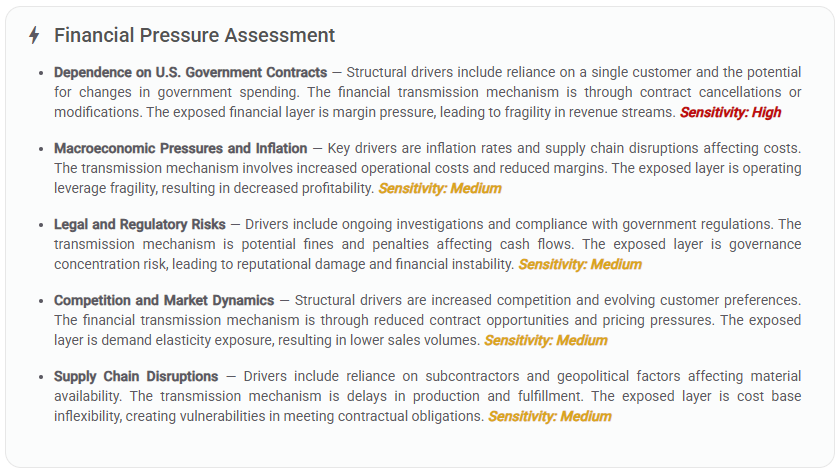
Northrop Grumman’s core revenue comes from U.S. government contracts.
This creates a structural risk:
- Revenue concentration in a single customer
- Exposure to political decisions and budget cycles
- Potential contract cancellations or delays
In times of war, spending may increase — but it also becomes less predictable.
This means that growth is not purely market-driven, but politically driven.
Get the same level of analysis
2. Financial Pressure Beneath the Surface
The analysis highlights several financial risk factors:
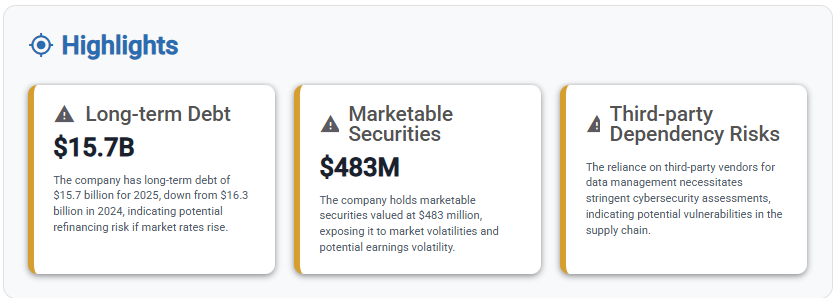
- $15.7B in long-term debt → refinancing risk if rates rise
- $483M in marketable securities → exposure to market volatility
- Inflation pressure → cost structure instability
These are not headline risks — but they directly affect:
- Margins
- Cash flow stability
- Long-term capital planning
3. Supply Chain Fragility in a War Environment
Defense companies rely heavily on complex global supply chains.
The 10-K highlights:
- Dependency on third-party vendors
- Cybersecurity risks in external systems
- Potential delays in production
In a geopolitical crisis, these risks amplify:
- Sanctions disrupt suppliers
- Logistics become unstable
- Costs increase unpredictably
This creates operational fragility — even in a sector that benefits from war.
4. Cybersecurity as a Structural Risk Layer
Unlike traditional industrial companies, Northrop Grumman operates in a high-risk digital environment.
The company maintains:
- Board-level oversight of cybersecurity
- Insider threat programs
- Continuous third-party risk assessments
This indicates one key point:
Cyber risk is not peripheral — it is structural.
In a war scenario, cyber threats can directly impact operations, contracts, and national security exposure.
5. The Real Risk: Financial Pressure, Not Just War Exposure
At first glance, defense companies benefit from conflict.
But the 10-K reveals a deeper layer:
- Revenue dependency risk
- Cost pressure from inflation
- Supply chain fragility
- Execution risk on contracts
These factors combine into what we define as financial pressure.
This is where the real investment risk lies.
Key Highlights from the Analysis
Final Insight
Northrop Grumman is not just a defense company.
It is a system exposed to:
- Geopolitical volatility
- Government dependency
- Operational and financial constraints
Understanding these dynamics requires going beyond headlines.
This analysis was generated in under 60 seconds using StockCompass.
This analysis took 45 seconds with StockCompass.
Analyze any company in seconds