Lockheed Martin’s 10-K: When Backlog Strength Meets Structural Rigidity

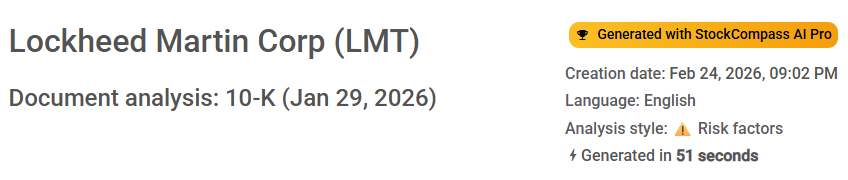
Document analyzed: Lockheed Martin Corp (LMT) — Form 10-K filed Jan 29, 2026.
Analysis style: Risk factors. Generated with StockCompass AI Pro in 51 seconds (creation date: Feb 24, 2026).
Defense contractors are often perceived as stable by design. Long-term government contracts. Multi-year programs. Predictable demand.
Lockheed Martin’s latest 10-K confirms the strength of that model — but it also highlights something less discussed: stability built on concentrated dependency and execution precision.
The structural question is not whether demand exists. It is whether contract concentration, supply chain fragility, and development complexity create financial rigidity under stress.
This analysis was generated in 51 seconds with StockCompass.
Explore the platform: https://stockcompass.io
1) Government Contract Dependency: Concentration Risk by Design
Lockheed Martin’s operations remain heavily reliant on U.S. Government contracts. That concentration provides visibility — but it also introduces structural exposure.
Budget shifts, political transitions, or procurement reprioritization can affect contract timing, funding cadence, and renewal probability.
This is not cyclical demand risk. It is policy-driven revenue concentration.
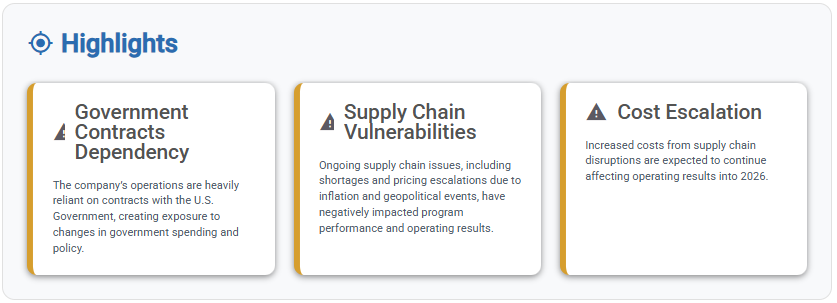
2) Supply Chain Vulnerabilities: Scarcity Meets Complexity
Advanced defense systems require complex global supply chains, including scarce raw materials such as rare earth minerals.
The 10-K flags continued cost escalation and supply disruptions driven by inflation and geopolitical tensions.
In highly specialized programs, substitution is rarely simple. Delays cascade. Costs compound. Margins compress.
The risk is not shortage alone. It is cost base inflexibility under constrained inputs.
3) Program-Specific and Technological Development Risk
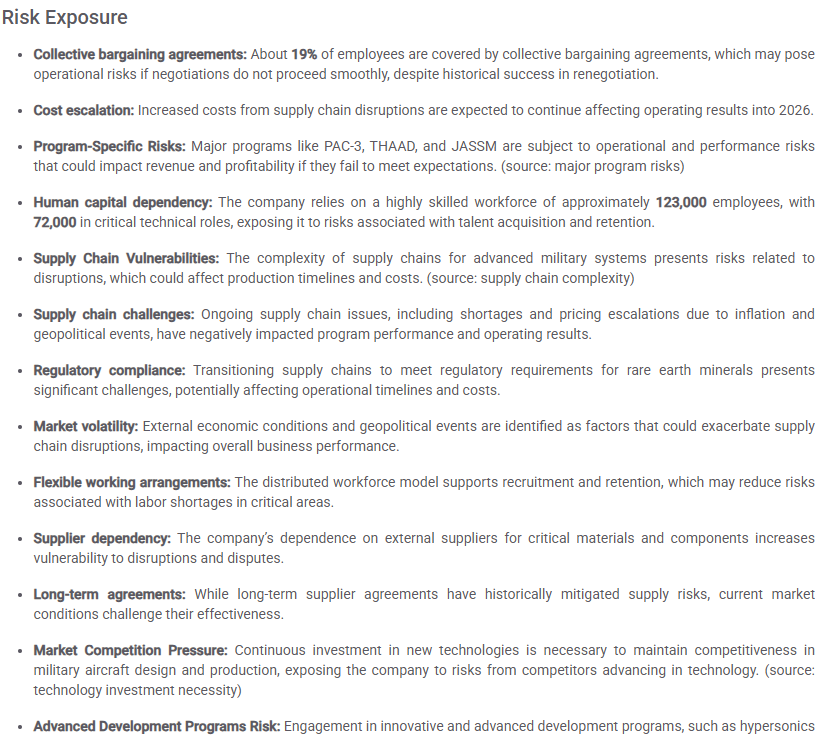
Programs such as PAC-3, THAAD, JASSM, and next-generation systems operate under strict performance and delivery expectations.
Many contracts are fixed-price. If development costs exceed projections, profitability absorbs the difference.
As Lockheed increases investment in hypersonics and unmanned systems, technological feasibility risk and execution precision become critical.
This is where innovation exposure intersects with operating leverage fragility.
4) Human Capital and Workforce Concentration
Approximately 123,000 employees — including around 72,000 in critical technical roles — form the backbone of program execution.
About 19% are covered by collective bargaining agreements.
Workforce stability supports continuity. But concentration of technical expertise also creates operational sensitivity if retention or negotiation dynamics shift.
In advanced defense systems, talent scarcity translates directly into execution risk.
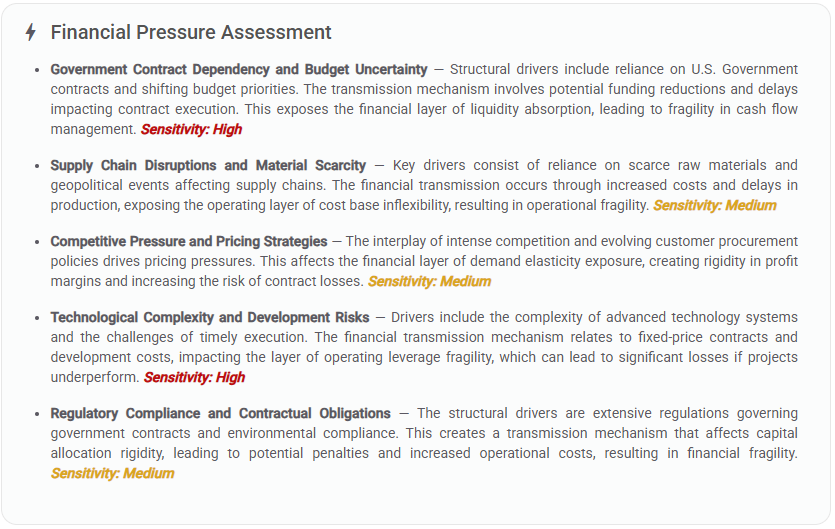
5) Financial Pressure Mapping: Where Fragility Concentrates
The Financial Pressure Assessment identifies two high-sensitivity layers:
- Government Contract Dependency & Budget Uncertainty (High)
- Technological Complexity & Development Risk (High)
Medium-pressure layers include:
- Supply chain disruption & material scarcity
- Competitive pricing pressure
- Regulatory compliance rigidity
Together, they outline a company that is not unstable — but structurally sensitive to funding cadence, execution accuracy, and cost containment.
Structural Takeaway
Lockheed Martin’s model is built for durability. Long-cycle contracts. High barriers to entry. Technical specialization.
But durability is paired with rigidity.
Revenue concentration on government budgets, fixed-price program exposure, material scarcity, and innovation complexity create a structure that performs well under policy continuity — and tightens under disruption.
The risk is not demand disappearance. It is execution stress under constrained flexibility.
StockCompass transforms SEC filings into structured risk and pressure maps in under a minute.
Explore: https://stockcompass.io
View plans: https://stockcompass.io/pricing