
Inside Tesla’s 10-Q: When Supply Chain Fragility Starts to Pressure Liquidity and Flexibility

Document analyzed: Tesla, Inc. (TSLA) — Form 10-Q filed Jan 29, 2026.
Analysis style: Risk factors. Generated with StockCompass AI Pro.
Tesla’s latest 10-Q highlights familiar themes: innovation, AI integration, manufacturing scale, and strategic investments.
What becomes structurally relevant is different: operational scale is increasing faster than financial flexibility.
Supply chain dependence, capital intensity, and demand volatility are no longer isolated risks. They interact — and that interaction is where financial pressure builds.
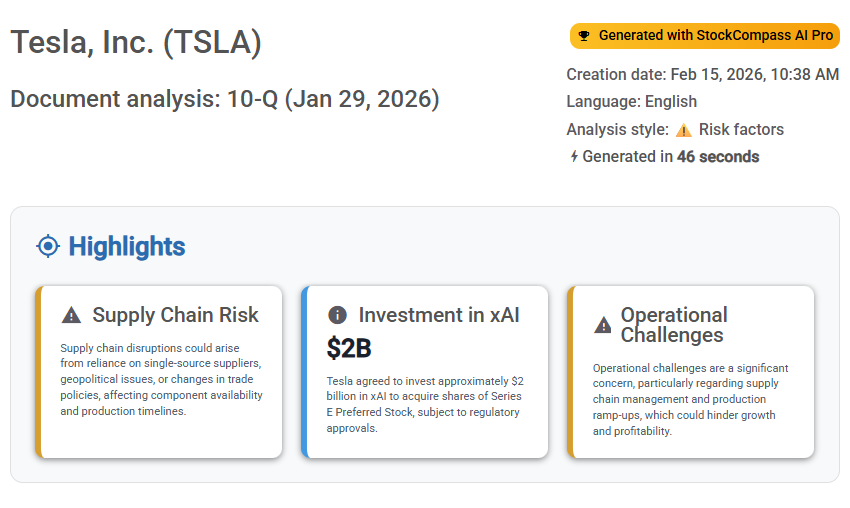
Supply chain risk becomes a liquidity variable
The filing emphasizes reliance on single-source suppliers and exposure to geopolitical trade dynamics. In isolation, this reads as an operational warning.
Structurally, it translates into liquidity absorption risk. Production delays do not just reduce output. They disrupt inventory cycles, increase working capital needs, and compress cash conversion efficiency.
When manufacturing scale is high, even minor disruptions amplify financial strain. Fragility grows with scale.
Capital intensity rises before operating leverage stabilizes
Tesla continues expanding AI capabilities, energy infrastructure, and manufacturing capacity.
These investments are necessary. But they introduce capital allocation rigidity.
Large fixed commitments reduce flexibility precisely when demand volatility, pricing pressure, and competitive intensity persist.
The balance becomes delicate: scale requires capital, yet capital reduces optionality.
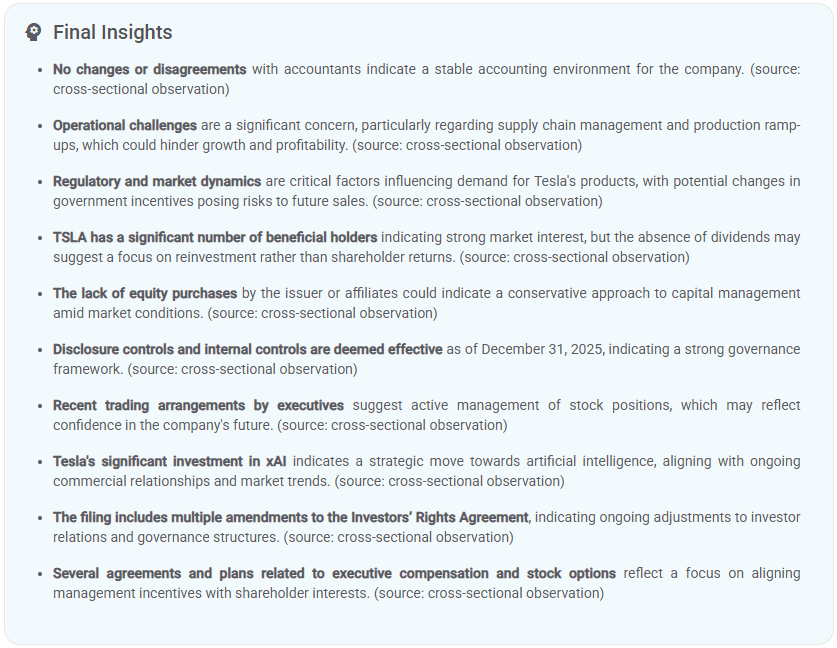
Execution concentration amplifies structural fragility
AI integration, autonomous development, battery supply dependence, and regulatory exposure converge into a single structural dynamic: execution concentration.
When multiple growth initiatives depend on synchronized execution, delays in one area propagate pressure across the system.
This is where operating leverage fragility appears. Fixed cost structures scale faster than revenue certainty.
The structural takeaway
Tesla’s risk is not about innovation capacity. It is about how tightly liquidity, capital rigidity, and execution complexity are now interconnected.
Supply chain fragility pressures cash. Capital intensity reduces flexibility. Demand volatility limits pricing power.
When these variables align, margin compression and liquidity strain can materialize faster than headline growth suggests.
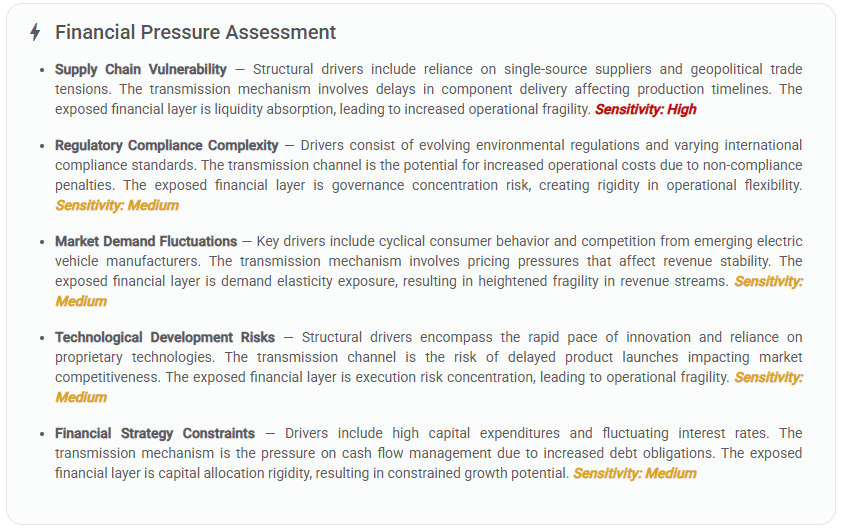
Screenshot: AI-generated Financial Pressure Assessment based on Tesla’s latest 10-Q.
The model does not flag headline risk, it flags structural pressure.
Supply chain dependency ranks as high sensitivity because it directly impacts production continuity, margin stability, and working capital absorption. The pressure is not theoretical — it transmits operational delays into financial fragility.
Capital allocation rigidity and execution concentration further compound the risk surface. When growth depends on flawless ramp execution, small disruptions can cascade into outsized financial impact.
This is not about demand collapse. It is about operational elasticity.
Extracted in seconds
Identifying this structural stress map requires connecting risk disclosures, capital commitments, and operating dynamics across sections of the filing.
This analysis was generated in less than a minute using StockCompass AI Pro.
Analyze a 10-Q with StockCompass
Disclaimer: This content is for informational purposes only and does not constitute investment advice.